

Tecnogen
Tecnogen
In recent years, Tecnogen has oriented its activities toward an increasing increase in its production capacity, focusing on the highest product quality and the evolution of new technologies.
In order to better meet the needs of an ever-changing global market, Tecnogen has designed new lines of compact, reliable and ultra-quiet gensets, focused on new hybrid solutions applied to the energy sector and on Led technology for lighting bodies of its light towers.
All production processes are managed in-house and all plants are located in Italy.
Tecnogen IN BRIEF Nearly 40 years of experience A production capacity of more than 35,000 units for the global market A distribution network in more than 50 countries 3 production plants with a total area of 90,000m2 with 62,000m2 of covered area International presence with offices in Great Britain, Germany and Singapore
OUR LEADING ROLE ON THE GLOBAL MARKET Tecnogen has always been committed to invest in RESEARCH and INNOVATION providing its customers with a wide range of products among the most complete in the world.
Over the last years TECNOGEN has been oriented towards increasing its PRODUCTION CAPABILITY and the QUALITY of its products focusing on the EVOLUTION of NEW TECHNOLOGIES.
To better meet the needs of an evolving global market, TECNOGEN has designed new Lines of products which includes compact, reliable and ultra-silent generating sets, has focused on new hybrid solutions applied to the energy sector and on LED technology for lighting towers.
All production processes are managed internally.
All the production plants are located in ITALY.
INTRODUCING TECNOGEN Almost 20 years of experience Production capacity of over 35,000 units for the global market Distribution network in more than 50 different countries 3 production plants with a total area of 90,000 m2 with 62,000 m2 covered area Worldwide branch of ces in UK, Germany, Singapore.

Bocconi University
Bocconi University
Since then, the University has been fulfilling its cultural role in society consistently with its vocation as a free, open and pluralistic institution, independent of any external conditioning, autonomous both economically and scientifically and didactically.Bocconi today constitutes a scientific and cultural point of reference in the economic, managerial, quantitative and legal sciences.
Sacred Heart Catholic University
Sacred Heart Catholic University
The University is fully inserted in the European tradition as a place of cultural elaboration capable of reading and interpreting the complexity of the reality in which we are immersed: a mission that translates into an educational proposal focused on the integral formation of the person.
Its history began in 1921, when the Catholic University was founded by Father Agostino Gemelli together with a group of Catholic intellectuals.
Since then, it has offered students not only a solid cultural preparation and indispensable professional skills, but also a clear educational proposal.
Distinctive features are the articulated and multidisciplinaryeducational offer , the rigor of studies, the close link with the world of work and professions, and the international openness.
Thanks to its scientific research, publications and reputation, Cattolica is accredited among the most prestigious universities in Europe and the world.
VITAL - ZANE & CO.
VITAL - ZANE & CO.
It brings with it the great wealth of experience of Marco Vitale, who has been a protagonist of Italian economic development since 1979, accompanying companies and entrepreneurs in many relevant business stories.
Members include Considi, which since 1980, among the first in Italy, has applied the logic of lean thinking to business processes to increase efficiency and competitiveness.
The focus of action is the Enterprise and in particular its development and its cultural and organizational evolution.
In this context, Vitale-Zane & Co. offers the following services:
- Strategic management consulting and advisory for both development projects and corporate and financial reorganization and restructuring situations
- Innovation and change for competitiveness
- Corporate Finance, assisting the Enterprise in strategic and operational decisions related to corporate finance
- Advising entities or institutions in the development of territorial or sectoral development projects and their implementation
Vitale-Zane & Co. is a partner of Borsa Italiana for the ELITE platform dedicated to SMEs with growth projects, with the aim of preparing them for access to the development capital market.”
LIVE energy
Giacomo
VIVI energia is the energy provider that charges the lives of its customers.
It aims to be at the side of households and businesses by providing value-added services and supporting their every need to build a new idea of energy together.
In addition to supplying gas and electricity from renewable sources, it offers energy efficiency solutions, from environmentally friendly boilers and air conditioners to support better use of energy resources, to installation of photovoltaic systems, lighting system upgrading projects, cogeneration plants, and e-mobility services.
To meet its customers’ demand for energy, VIVI energia provides a network of 28 VIVI stores located in the areas of Novara, Bergamo, Brescia, Lodi, Milan, Monza, Pavia, Rome, Terni, Varese, Verbania, Verona, and Viterbo, as well as a team of agents and consultants.
Commitment to customer satisfaction has found further confirmation in the Quality Certification of its management system, according to UNI EN ISO 9001:2015, an achievement that testifies to the results achieved in the various business sectors.
Yamamay
Giacomo
At Yamamay, the product, in its most innovative aspect, is strongly linked to the company’s purpose, where the well-being of customers is placed at the center of our operations, thanks to an offer of durable and high quality products flanked by a special attention to sustainability and responsibility of our actions.
For this reason, the research activity we conduct aimed at creating products that meet our customers’ needs in terms of quality, safety, and innovation is constantly on the rise.
Inclusiveness, respect and valuing people are the fundamental elements on which we base our relationship with human capital, local communities, suppliers and all those with whom we collaborate.
Likewise, we believe that being able to convey our values clearly to employees, guiding and informing them, especially in relation to environmental and social issues, is a prerogative for activating real change, which can only be achieved with the involvement and contribution of everyone.
George Basile
Giacomo
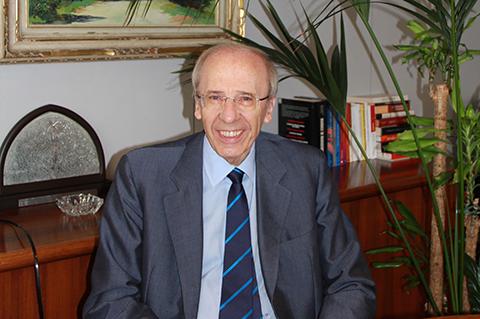
We talk to Giorgio Basile, president and CEO of Isagro
President, could you introduce Isagro to us, highlighting its mission and values?
We are an Italian company of more than 600 employees engaged in research, development, production and distribution of agropharmaceuticals, i.e., products for agricultural crop protection.
We invest in innovation and development of new molecules with low environmental impact.
Established in 1993, we have been listed on the Italian Stock Exchange’s STAR segment since 2003.
We produce in 5 plants including 4 in Italy and 1 in India and sell to 80 countries.
We have always asked a question that all managers and entrepreneurs should seriously ask themselves, in every sector: what contribution does our business make to the well-being of people and the planet?
Let’s start with a very concrete scenario: when we are 9 billion in 2050 we will need more food than today; since we cannot increase the arable area by much, we have to make sure that the yield per hectare of agricultural areas increases, a goal, however, that necessarily has to be reconciled with ensuring the lowest possible environmental impact and maintaining the effectiveness of the pesticides used.
That’s our mission: to discover molecules to make effective products with less and less environmental impact.
In an industry like yours, where the R&D function is key to the business, how do you manage to be innovative?
Research investment for us accounts for as much as 10 percent of sales, and employees engaged in R&D are about 100 out of 600.
When we talk about R&D we at Isagro refer not to a general effort to improve products, etc., but to actual “discovery,” that is, the discovery of innovative new molecules.
We are among the very few companies in the world in this sector to do so, even in our small size, but we manage to be extremely competitive by leveraging “Italian creativity” applied to plant protection and health.
So can we talk about the value of Made in Italy in a globalized world even in a specific sector like agriculture?
Yes, we have developed a business model of which we are very proud: it is a pathway that from the discovery phase of active molecules for agricultural defense products takes us to the second phase of placing them on the market through alliances with international partners with whom we share the very high investments required in the development, registration and marketing phase of plant protection products.
Investments that we could not sustain alone, because we would risk “overspending” beyond financial capacity and at the same time “underinvesting” compared to needs.
For this reason, we have developed “mosaic” agreements that may involve co-ownership of development with some international companies, such as the one in 2012 with FMC Corporation: a collaboration agreement for the development of a new fungicide discovered by us that has a broad spectrum of action and potential for use worldwide.
Thanks to this partnership today we are well advanced in the development of the product that we expect to bring to market early in the next decade.
Michael Alessi
Giacomo
We talk to Michele Alessi Vice President of Alessi SpA
Alessi is a world-leading industrial design company, a symbol of Made in Italy, which became B-Corp in 2017.
What is the underlying vision that guides the way you do business?
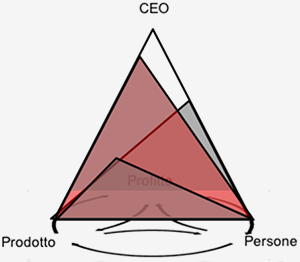
The “Virtuous Circle” model, inspired by the work of Vittorio Coda, is at once my way of looking at the enterprise, the purpose I ascribe to it, the value orientation, the decision-making model I use (even implicitly), and the reference for measuring impact.
The model has over time been adapted to the reality of Alessi and simplified into what, for disclosure purposes, I call the “3 P’s model.”
The simplified vision
In summary, the model represents the enterprise as a virtuous circle revolving around 3 constituent elements: the People, from whom everything begins; the Product, which connects us to the true lord and master of every business, the customer; and the Profit, without which the business cannot survive.
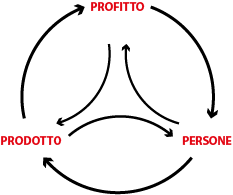
Alessi’s specific purpose, as I see it.
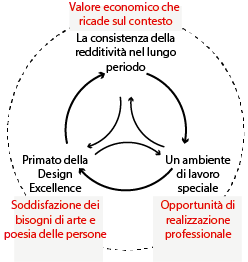
The Virtuous Circle expresses a threefold purpose, not three purposes that somehow add up.
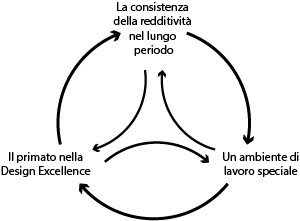
Alessi’s purpose is to pursue these three goals at the same time, keeping them in balance with each other and making sure that they positively influence each other:
Primacy in Design Excellence
The consistency of profitability in the long run
A special working environment
CV as comet star, to inspire and guide decisions
The Virtuous Circle is a high-level representation of a vision.
While not designed as an operational tool, it also guides and directs management.
The most natural way to use it is to regard it as a comet star: a reference to follow when faced with crossroads.
That promises us a goal of satisfaction even if and when we do not yet see it clearly.
The beauty, and the difficult part, is the compromise, the mediation between the three goals to be kept in mind simultaneously; it is also the challenge that, personally, leads me to unearth solutions that at first glance may elude us.
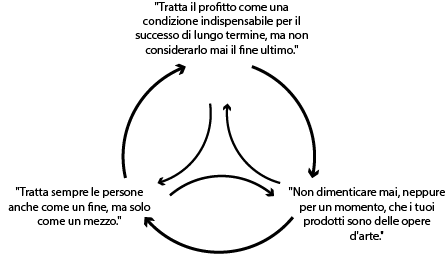
The CV for the dissemination of a systemic vision in the company
In my interpretation, every corporate role, every activity, at every level, directly or indirectly impacts all three components.
The higher you go up the hierarchical ladder of the company, the more necessary it is to have a circular outlook.
Going down, of course, perspectives change, but it remains important at all levels to avoid the “polarization” of viewpoints: this representation invites everyone to broaden his or her gaze, while safeguarding his or her specialization.
The impact on the context
It was very nice to realize that the same goals that I consider so central and indispensable to the success of our enterprise also imply a benefit to society.
This is the little bit of good news that I would like to continue to testify to: that, provided we adopt a sound conception of the purpose of the enterprise and thus of its social role, the good of the company goes hand in hand with the good of all the stakeholders with whom it relates: the enterprise is made to grow along with its context.
Can you give us some examples of concrete application of this way of looking at business?
I recount two “emblematic” projects, born in different contexts and with very different specific weight, but perhaps helpful in better understanding the implications (and impact) of a circular vision.
“MAKE OR BUY?”
In 2008, at the onset of the economic crisis, there arises (not for the first time) the need to question the sustainability of the Crusinallo Factory and the possibility of taking the road, taken by most, of relocating.
Beyond the ownership’s desire to keep production in the territory, there arises the need to question it to ensure the consistency of economic results for the company.
Project development involves many business functions: general management, product marketing, purchasing, production, human resources
Elements that came into play in the decision
- Profit
- production costs vs. purchase costs (with estimates on actual products as examples)
- impact on indirect costs
- depreciation of mold costs
- costs of staff reduction
- Careful not to take irreversible steps, with a view to prudence
- People
- Impact of relocation in terms of staff reduction
- Flexibility to change on the part of people (maintaining the factory must be a shared effort)
- Product
- Desire to preserve the “workshop of applied art” that the factory represents: design and product are born in the same place and observe each other
- Protection of technological presidium on cold metal stamping
- Ability to produce in small batches (essential to a “design encyclopedia” made up of over 3000 pieces) and flexibility in production times, in response to difficult orders
- Made in Italy brand distinctiveness
- Community and Environment
- Effects on local supply chain
- Disposal of decommissioned facilities
Outcome of the decision-making process
- Choice to maintain the Factory, without job cuts and containing access to CIGO as much as possible
- Review of decision-making (with a view to balancing purchasing and production) and production processes (with a view to maximizing efficiency and nontraumatic optimization of production costs)
- New flexible contract agreed with unions
- Development of design projects and marketing initiatives specifically aimed at increasing factory production hours.
By way of example:- (UN)Forbidden City (2012), an illustrative chapter in Alessi’s activity of exploring new international expressive languages, created with the specific goal of creating objects designed in Asia but to be produced in Crusinallo, based on the provocative brief “Designed in China, made in Italy.”
- “Cut and Fold” (2013) is the title of a project brief created with the intention of “directing” the creativity of the designers, involved through competition, toward projects that can be produced in the Crusinallo factory.
The use of lasers, together with simple metal bending, allows for the generation of complex shapes for low investment, thanks to the plant’s technological oversight.
“GOOD WORK, THE FACTORY FOR THE CITY”
2013 was marked by the extraordinary concurrence of a time of overcapacity, and a year of excellent profitability.
The Layoff Benefits Fund, an important industrial crisis management tool, has always been “disliked” by the company because of the negativity of the message it sends to people, far removed from the culture of valuing work in which we have always believed.
We were therefore afforded the luxury and challenge of finding an alternative and more coherent solution, for the management of redundant hours, with the main objective of strengthening the relationship with people, restoring value to their work at a time of crisis.
Again, the development of the project, transversally involved multiple business functions: Human Resources, Production, Administration, Communication
Elements that came into play in the decision
- People
- Desire to send a positive and motivating message in the face of factory downtime
- Need to give (useful) employment to factory employees, alternative to their ordinary employment in production
- Compatibility of organizing an outside activity with the need to carry on ordinary activities in the company
- Attention to people’s wishes (also in terms of activities to be performed)
- Profit
- Costs associated with the non-activation of CIGO
- Reasonableness of the investment (with respect to noneconomic returns)
- Product
- Opportunity to counter negativity, including in terms of image, related to the factory’s moment of crisis
- Opportunities to demonstrate creativity and innovation in contexts other than product design
- Community and Environment
- Ability to respond effectively to community needs through people’s work
- Indirect opportunity to strengthen the relationship with the territory
Outcome of the decision-making process
- Instead of activating the layoff fund, it was proposed that employees at the Omegna office devote part of their regularly paid time to socially useful activities for the benefit of the local community.
- Participation, which was totally voluntary, was 88 percent, for a total of 9712 man-hours devoted to activities such as repainting the school, cleaning roads and paths, and accompanying the elderly and disabled.
The initiative also involved another 42 people (retirees, agents, vendors, volunteers) for an additional 436 volunteer hours. - In the survey conducted in early 2018 (5 years after the project), 95% of employees say they appreciate Alessi’s community outreach initiative and 75% confirm that it has positively affected their relationship with the company.
- In terms of communication, returns have also been extremely positive.
The total estimated value of the outputs between print, radio and TV is more than 3.5 million euros (almost 12 times the total cost of the project). - Finally, the project has inspired a bill, presented by Senator Ichino and signed by a bipartisan group of parliamentarians, aimed at institutionalizing and incentivizing volunteerism as an alternative practice to the layoff fund.
Evolution of the project
In the years following 2015, market conditions and production declines made it imperative to activate periods of Ordinary Layoff Benefits Fund.
With the aim of continuing to support workers’ commitment to the local community, Alessi activated the “Good Work – Lend a Hand”, pledging to supplement the salary paid by INPS for the hours employees choose to devote to volunteer activities.
While differing in form, this initiative stems from the same spirit and goals that had led to the implementation of the “Good Work 2013” project: to value people’s work, even at times when it cannot be employed in the company, and to pay special attention to the Community in which the company operates and we all live.
How did Alessi decide to become a B Corp, and what does it mean concretely to be one?
B Corps are companies that, convinced that their purpose does not end with the pursuit of profit, work to maximize their positive impact on employees, the communities in which they operate and the environment, using business as a regenerative force for society and the well-being of the planet.
Becoming a B Corp therefore has meant, from my perspective, translating into a formal and recognizable certification what for me has always been the meaning of “doing business.” Bringing Art and Poetry into industrial production, satisfying the cultural and aesthetic needs of the public; operating responsibly and transparently in the management of people, valuing their work by creating opportunities for the development of professional identity; pursuing a fair and sustainable profit, creating wealth for the context as well: three strategic goals that reinforce each other, creating a virtuous circle in which the success of the business and the good of the community are at stake at the same time.
The certification was obtained after successful completion of a complex and multifaceted impact assessment process (B Impact Assessment), which was created to verify that the company’s activities are directed toward achieving a positive effect on the community, not only in economic terms but also in terms of social and environmental impact.
The assessment considers practices, initiatives and achievements in five thematic areas: governance, employee relations, customer relations, the company’s role in the community, and environmental sustainability of processes and products.
In each of these areas, Alessi has been rated higher than the average of 55,000 companies that undergo the assessment (of which only 2178 in 50 countries and 130 industries have so far achieved certification).
One thing that makes me particularly proud is that, to achieve this, it was not necessary to implement any changes in processes: it was enough to tell what we already were, what we used to do.
Not just in terms of extraordinary activities (which we also do and like to do), but precisely through our business activity and the way it is carried out.
Not only having our own museum, which makes the cultural heritage built up over nearly 100 years of work accessible, but the fact in itself that our products are in the permanent exhibitions of more than 50 contemporary art museums, which certifies that we bring more than 350,000 works of art into people’s homes every year.
It is not so much the fact of doing charity, in the amount of 2 percent of the annual profit, but the choice to distribute the economic value produced in a fair and responsible way, among all those who help create it (starting with the employees, to whom about 10 percent of the ebit goes in terms of performance bonus and participation in the company’s results).
Not just the special projects for employees and their families, which do exist and qualify the relationship with them, but the fact in itself of fighting to secure 4.4 percent of industry jobs today in a province that has suffered dramatically from the backlash of the crisis over the past 20 years.
Fabio Liberali
Giacomo
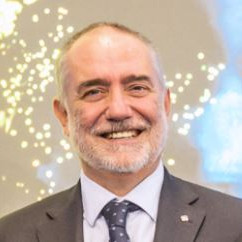
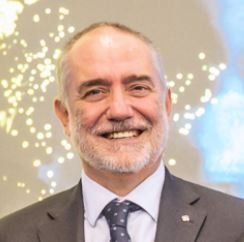
We talk with Fabio Liberali, Lu-Ve Group
Can you tell us about Lu-Ve Group’s way of doing business?
LU-VE Group originated more than 32 years ago, when my father had the intuition to take over a high quality company, but then in crisis due to inappropriate management.
Under his leadership we have become one of the world’s leading manufacturers in the heat exchanger industry, present in various market segments, from commercial and industrial refrigeration to civil, industrial and precision air conditioning.
The Group today is strong with more than 2,700 employees with 80 percent of production exported to 100 countries and a turnover that will exceed 300 million euros at the end of 2018.
LU-VE means Lucky Venture, a name that really led to a lucky venture!
This extraordinary growth has been built on an important foundation made up of strong principles that our founder himself has always transferred to every activity and which can be summarized in two assumptions.
“Businesses are women, men, and ideas”-meaning that for us everything has to start with a focus on people in the way we do business.
“Gray matter is our raw material”: without ideas there is no innovation, and without innovation a company cannot grow.
But…where do ideas come from?
From people, and here we come back to our fundamental assumption that puts human resources at the center.
The vocation for innovation therefore is key for Lu-Ve: not only is it a driver of growth, but it is also a value cornerstone.
How do you develop it?
We have always opened ourselves to the outside world with a network of collaborations with research institutions and academia.
Here, too, we go back to our roots: since our founding, we have set out on a true path of collaboration with the academic and institutional world of research, thus managing to develop one of the largest R&D laboratories in Europe in our field.
This is an ongoing and multifaceted journey: recently, for example, we renewed our partnership with the Milan Polytechnic for the next three years: a more than 30-year partnership dating back to the year of its founding.
It is an R&D model that we also replicate whenever we open up globally: when we set up new companies abroad, we immediately select and then contact the best local universities, with a twofold objective: to find people and brains to hire on site and, secondly, to open ourselves up to new stimuli for product innovation.
This approach enabled us to become the first company in the world to apply cutting-edge solutions to commercial and industrial refrigeration: we introduced a new way of conceiving and making refrigeration and air conditioning products, according to cutting-edge technologies that have since become a constant reference for the entire industry.
Not only that, immersing oneself in local realities, through the involvement of local people, allows one to give, but also to receive: in India, in Chennai, we are collaborating with other companies, with the Indian Institute of Technology Madras, on a pilot project on the use of new refrigerants.
In China we had interns from John Carroll University, studying to become Western managers in the country.
Does environmental value and focus on people bring innovation and growth?
Since our founding and far ahead of the rest of the industry, we have been dedicated to environmental issues, approaching sustainability in the way that suits us best, which is by putting our best brains into the field through R&D.
We were among the first in our industry to integrate environmental impact reduction goals into the business, both in terms of products and production processes, seeking to combine environmental concern with business development.
With a pioneering approach, we proposed products to the market that anticipated solutions (technical and on the use of refrigerants) that would later become a market standard.
After initial difficulties and resistance found in proposing a real “game changer,” this cutting-edge vision has been recognized by the market and has been one of the growth drivers that have enabled us to take a leadership role in the industry.
Finally, allow me to close with a reminder of the first fundamental assumption for LU-VE, “a company made up of women, men and ideas”: in today’s globalized world, attention to people goes hand in hand with valuing diversity, conceived as an asset to be cared for and harmonized.
On the one hand, our company goes to settle in very different nations, just think that we have 12 production plants in 8 different countries (Italy, China, India, Sweden, Poland, the Czech Republic, Russia and the USA): as mentioned, in each we look for local partners to integrate as much as possible into the new reality.
In parallel, at our headquarters in Uboldo, in the province of Varese, we count as many as 14 different nationalities: here, too, we need to allow everyone to integrate.
We have organized Italian courses so that all workers are on an equal footing and are in the same conditions to fully understand first of all the safety rules and then also their rights.
We also used these training moments to teach the Italian Constitution and the founding norms of our country.
In terms of safety, in the Uboldo (Varese) plant we have created “training breaks”: a new way of creating a safety culture.
These are short intervals made at workstations in which to “go over” rules and operating procedures to preserve and constantly improve safety at work.
The system is so good that it has been adopted by the National Health and Safety Commission of Federmeccanica-Assistal, Fiom-Fim-Uilm as a methodology available throughout Italy for companies in the metalworking sector.
Finally, we try to set a good example: for many years we have been cooperating with the Alfa Cooperative, a social cooperative founded by doctor Antonio Gervasio, which makes it possible to bring people with mental problems into the business world, using work as therapy.
AKNO Group
The AKNO Group was founded in 1971 and for fifty years, with the AKNO Business Parks division, has been active in the real estate and construction market sector, establishing itself today as a leader in the implementation and management of industrial and logistics projects globally.
Over time, the Group has met the challenges of engineering development by investing its know-how in increasingly innovative methodologies.
The buildings and facilities offered by AKNO meet the strictest standards of quality, innovation and technological advancement.
Each civil and industrial complex has received awards and to international recognition executes a specific philosophy: to add value by building a comfortable and safe environment.
That is why AKNO Group, through its AKNO Energy division, offers projects capable of respecting the environment, models of maximum efficiency and safety made by sticking to a proven construction scheme to best meet the needs of the market, customers and collaborators.
Over the past few years, a new division of the Group, AKNO Hotels, has been established, which, thanks to its experience and wide range of multidisciplinary professionalism, is able to successfully carry out small and large works in the tourist-hotel sector, offering visitors the best habitat by combining modernity and safety.
The AKNO Engineering & Construction and AKNO Management Services divisions were then added to meet the needs of the many Customers.