
Michael Alessi
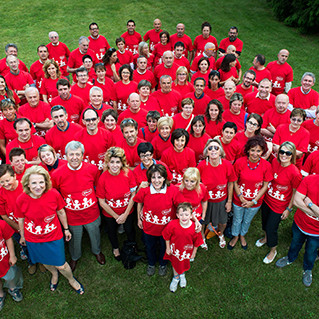
We talk to Michele Alessi Vice President of Alessi SpA
Alessi is a world-leading industrial design company, a symbol of Made in Italy, which became B-Corp in 2017.
What is the underlying vision that guides the way you do business?
The “Virtuous Circle” model, inspired by the work of Vittorio Coda, is at once my way of looking at the enterprise, the purpose I ascribe to it, the value orientation, the decision-making model I use (even implicitly), and the reference for measuring impact.
The model has over time been adapted to the reality of Alessi and simplified into what, for disclosure purposes, I call the “3 P’s model.”
The simplified vision
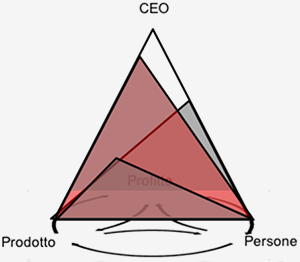
In summary, the model represents the enterprise as a virtuous circle revolving around 3 constituent elements: the People, from whom everything begins; the Product, which connects us to the true lord and master of every business, the customer; and the Profit, without which the business cannot survive.
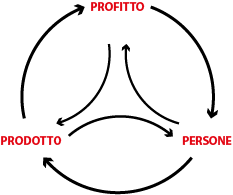
Alessi’s specific purpose, as I see it.
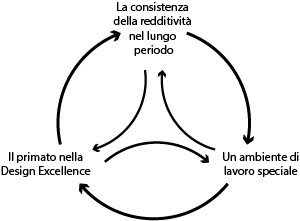
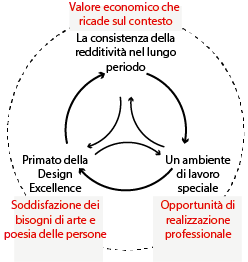
The Virtuous Circle expresses a threefold purpose, not three purposes that somehow add up.
Alessi’s purpose is to pursue these three goals at the same time, keeping them in balance with each other and making sure that they positively influence each other:
Primacy in Design Excellence
The consistency of profitability in the long run
A special working environment
CV as comet star, to inspire and guide decisions
The Virtuous Circle is a high-level representation of a vision.
While not designed as an operational tool, it also guides and directs management.
The most natural way to use it is to regard it as a comet star: a reference to follow when faced with crossroads.
That promises us a goal of satisfaction even if and when we do not yet see it clearly.
The beauty, and the difficult part, is the compromise, the mediation between the three goals to be kept in mind simultaneously; it is also the challenge that, personally, leads me to unearth solutions that at first glance may elude us.
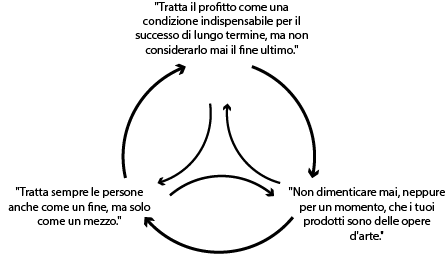
The CV for the dissemination of a systemic vision in the company
In my interpretation, every corporate role, every activity, at every level, directly or indirectly impacts all three components.
The higher you go up the hierarchical ladder of the company, the more necessary it is to have a circular outlook.
Going down, of course, perspectives change, but it remains important at all levels to avoid the “polarization” of viewpoints: this representation invites everyone to broaden his or her gaze, while safeguarding his or her specialization.
The impact on the context
It was very nice to realize that the same goals that I consider so central and indispensable to the success of our enterprise also imply a benefit to society.
This is the little bit of good news that I would like to continue to testify to: that, provided we adopt a sound conception of the purpose of the enterprise and thus of its social role, the good of the company goes hand in hand with the good of all the stakeholders with whom it relates: the enterprise is made to grow along with its context.
Can you give us some examples of concrete application of this way of looking at business?
I recount two “emblematic” projects, born in different contexts and with very different specific weight, but perhaps helpful in better understanding the implications (and impact) of a circular vision.
“MAKE OR BUY?”
In 2008, at the onset of the economic crisis, there arises (not for the first time) the need to question the sustainability of the Crusinallo Factory and the possibility of taking the road, taken by most, of relocating.
Beyond the ownership’s desire to keep production in the territory, there arises the need to question it to ensure the consistency of economic results for the company.
Project development involves many business functions: general management, product marketing, purchasing, production, human resources
Elements that came into play in the decision
- Profit
- production costs vs. purchase costs (with estimates on actual products as examples)
- impact on indirect costs
- depreciation of mold costs
- costs of staff reduction
- Careful not to take irreversible steps, with a view to prudence
- People
- Impact of relocation in terms of staff reduction
- Flexibility to change on the part of people (maintaining the factory must be a shared effort)
- Product
- Desire to preserve the “workshop of applied art” that the factory represents: design and product are born in the same place and observe each other
- Protection of technological presidium on cold metal stamping
- Ability to produce in small batches (essential to a “design encyclopedia” made up of over 3000 pieces) and flexibility in production times, in response to difficult orders
- Made in Italy brand distinctiveness
- Community and Environment
- Effects on local supply chain
- Disposal of decommissioned facilities
Outcome of the decision-making process
- Choice to maintain the Factory, without job cuts and containing access to CIGO as much as possible
- Review of decision-making (with a view to balancing purchasing and production) and production processes (with a view to maximizing efficiency and nontraumatic optimization of production costs)
- New flexible contract agreed with unions
- Development of design projects and marketing initiatives specifically aimed at increasing factory production hours.
By way of example:- (UN)Forbidden City (2012), an illustrative chapter in Alessi’s activity of exploring new international expressive languages, created with the specific goal of creating objects designed in Asia but to be produced in Crusinallo, based on the provocative brief “Designed in China, made in Italy.”
- “Cut and Fold” (2013) is the title of a project brief created with the intention of “directing” the creativity of the designers, involved through competition, toward projects that can be produced in the Crusinallo factory.
The use of lasers, together with simple metal bending, allows for the generation of complex shapes for low investment, thanks to the plant’s technological oversight.
“GOOD WORK, THE FACTORY FOR THE CITY”
2013 was marked by the extraordinary concurrence of a time of overcapacity, and a year of excellent profitability.
The Layoff Benefits Fund, an important industrial crisis management tool, has always been “disliked” by the company because of the negativity of the message it sends to people, far removed from the culture of valuing work in which we have always believed.
We were therefore afforded the luxury and challenge of finding an alternative and more coherent solution, for the management of redundant hours, with the main objective of strengthening the relationship with people, restoring value to their work at a time of crisis.
Again, the development of the project, transversally involved multiple business functions: Human Resources, Production, Administration, Communication
Elements that came into play in the decision
- People
- Desire to send a positive and motivating message in the face of factory downtime
- Need to give (useful) employment to factory employees, alternative to their ordinary employment in production
- Compatibility of organizing an outside activity with the need to carry on ordinary activities in the company
- Attention to people’s wishes (also in terms of activities to be performed)
- Profit
- Costs associated with the non-activation of CIGO
- Reasonableness of the investment (with respect to noneconomic returns)
- Product
- Opportunity to counter negativity, including in terms of image, related to the factory’s moment of crisis
- Opportunities to demonstrate creativity and innovation in contexts other than product design
- Community and Environment
- Ability to respond effectively to community needs through people’s work
- Indirect opportunity to strengthen the relationship with the territory
Outcome of the decision-making process
- Instead of activating the layoff fund, it was proposed that employees at the Omegna office devote part of their regularly paid time to socially useful activities for the benefit of the local community.
- Participation, which was totally voluntary, was 88 percent, for a total of 9712 man-hours devoted to activities such as repainting the school, cleaning roads and paths, and accompanying the elderly and disabled.
The initiative also involved another 42 people (retirees, agents, vendors, volunteers) for an additional 436 volunteer hours. - In the survey conducted in early 2018 (5 years after the project), 95% of employees say they appreciate Alessi’s community outreach initiative and 75% confirm that it has positively affected their relationship with the company.
- In terms of communication, returns have also been extremely positive.
The total estimated value of the outputs between print, radio and TV is more than 3.5 million euros (almost 12 times the total cost of the project). - Finally, the project has inspired a bill, presented by Senator Ichino and signed by a bipartisan group of parliamentarians, aimed at institutionalizing and incentivizing volunteerism as an alternative practice to the layoff fund.
Evolution of the project
In the years following 2015, market conditions and production declines made it imperative to activate periods of Ordinary Layoff Benefits Fund.
With the aim of continuing to support workers’ commitment to the local community, Alessi activated the “Good Work – Lend a Hand”, pledging to supplement the salary paid by INPS for the hours employees choose to devote to volunteer activities.
While differing in form, this initiative stems from the same spirit and goals that had led to the implementation of the “Good Work 2013” project: to value people’s work, even at times when it cannot be employed in the company, and to pay special attention to the Community in which the company operates and we all live.
How did Alessi decide to become a B Corp, and what does it mean concretely to be one?
B Corps are companies that, convinced that their purpose does not end with the pursuit of profit, work to maximize their positive impact on employees, the communities in which they operate and the environment, using business as a regenerative force for society and the well-being of the planet.
Becoming a B Corp therefore has meant, from my perspective, translating into a formal and recognizable certification what for me has always been the meaning of “doing business.” Bringing Art and Poetry into industrial production, satisfying the cultural and aesthetic needs of the public; operating responsibly and transparently in the management of people, valuing their work by creating opportunities for the development of professional identity; pursuing a fair and sustainable profit, creating wealth for the context as well: three strategic goals that reinforce each other, creating a virtuous circle in which the success of the business and the good of the community are at stake at the same time.
The certification was obtained after successful completion of a complex and multifaceted impact assessment process (B Impact Assessment), which was created to verify that the company’s activities are directed toward achieving a positive effect on the community, not only in economic terms but also in terms of social and environmental impact.
The assessment considers practices, initiatives and achievements in five thematic areas: governance, employee relations, customer relations, the company’s role in the community, and environmental sustainability of processes and products.
In each of these areas, Alessi has been rated higher than the average of 55,000 companies that undergo the assessment (of which only 2178 in 50 countries and 130 industries have so far achieved certification).
One thing that makes me particularly proud is that, to achieve this, it was not necessary to implement any changes in processes: it was enough to tell what we already were, what we used to do.
Not just in terms of extraordinary activities (which we also do and like to do), but precisely through our business activity and the way it is carried out.
Not only having our own museum, which makes the cultural heritage built up over nearly 100 years of work accessible, but the fact in itself that our products are in the permanent exhibitions of more than 50 contemporary art museums, which certifies that we bring more than 350,000 works of art into people’s homes every year.
It is not so much the fact of doing charity, in the amount of 2 percent of the annual profit, but the choice to distribute the economic value produced in a fair and responsible way, among all those who help create it (starting with the employees, to whom about 10 percent of the ebit goes in terms of performance bonus and participation in the company’s results).
Not just the special projects for employees and their families, which do exist and qualify the relationship with them, but the fact in itself of fighting to secure 4.4 percent of industry jobs today in a province that has suffered dramatically from the backlash of the crisis over the past 20 years.